Old Front Line
WW1 Podcast with Paul Reed
London Pride: The London Territorials in WW1
In this episode of the Old Front Line podcast, host Paul Reed is joined by military historians Charles Fair, Richard Hendry, and Dr. Tom Thorpe to delve into the often-overlooked history of the London Territorial Force during the Great War. The discussion begins with an exploration of the origins and purpose of the Territorial Force, established in 1908, which served primarily for home defense before the war. The historians highlight the unique characteristics of the London Regiment, which comprised numerous battalions, each with distinct identities tied to local communities, and how this diversity contributed to its prominence in the war effort.
As the conversation progresses, the historians discuss the evolution of the London Territorials throughout the war, noting how the composition of the units changed as conscription began and how the original local identities were diluted. They also touch on the social dynamics within the battalions, the challenges of equipment shortages, and the significant contributions of the London Territorials in various theatres of war, including the Western Front and Palestine. The episode concludes with insights into their upcoming book, “London Pride,” which aims to provide a comprehensive study of the London Territorial Force’s history and its impact on the Great War.
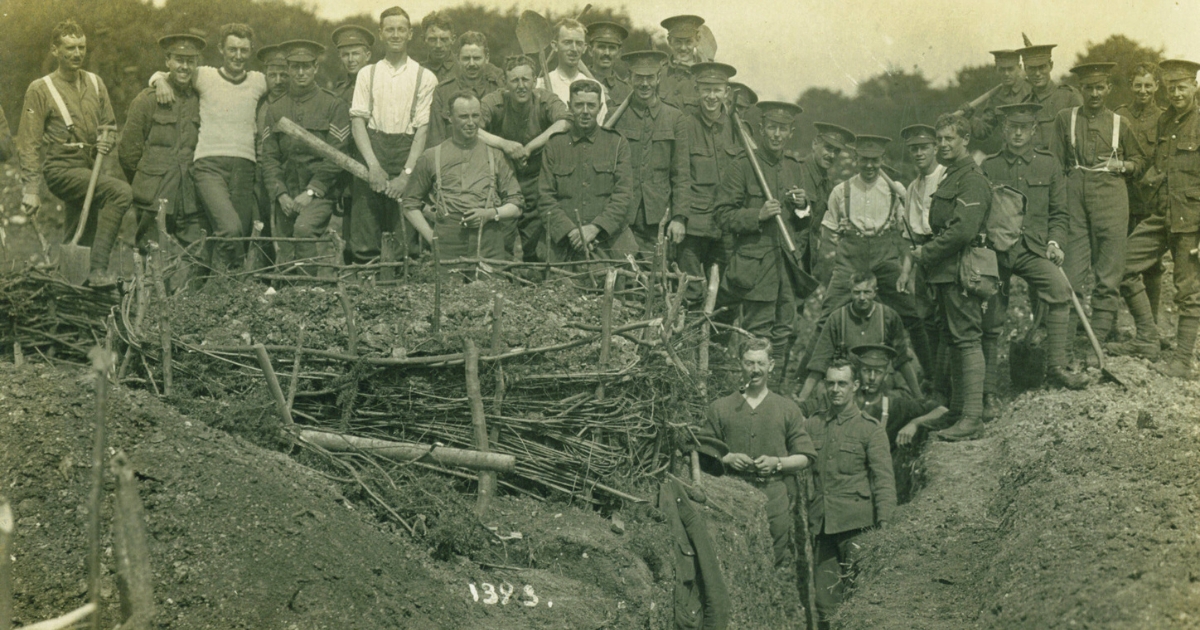
Main Image: Men of the 19th Battalion London Regiment digging trenches in England c.1915 (Old Front Line archives)
You can order the book here via the Publisher: London Pride The London Territorials in WW1
Sign up for the free podcast newsletter here: Old Front Line Bulletin.
You can order Old Front Line Merch via The Old Front Line Shop.
Got a question about this episode or any others? Drop your question into the Old Front Line Discord Server or email the podcast.
5 Comments on “London Pride: The London Territorials in WW1”
Leave a comment


 Old Front Line
Hello Paul,
I was pleasantly surprised to find out the topic of the podcast was about the London Territorials. Some background, I love old movies and there was one film, {“Random Harvest”{ that had Robert Colman as the main character. I discovered that Robert Colman was Colman was Private No. 2148 with the 1/14th (County of London) Battalion of the London Regiment (London Scottish). He sailed to Ypres in September 1914, was seriously wounded in the ankle, which gave him a limp that he sought to hide throughout his acting career: “Disability. Fracture of Ankle (Rt.) In action near Ypres 31-10-14. Man states that when advancing a shell burst near him, and he was thrown heavily injuring his right foot either by the fall or his foot being struck. There is considerable thickening of Rt. ankle. There is also some tenderness and after walking any distance there is pain and lameness.” Colman was treated at the field ambulance and was transferred to England the next day. He was admitted to St. Bartholomew’s Hospital in London, where he stayed from 6 to 11 November. Having sufficiently recovered, Colman was transferred to the 3/14 Battalion of the London Scottish and was sent to Perth, where he did light clerical duty and lived at Strathview (No. 75–77), Muirton Place. He was discharged as medically unfit and discharged May, 1915. I always wondered if his wartime experiences gave him material for being the Officer with Amnesia in the movie “Random Harvest”. Fellow Hollywood actors Claude Rains, Herbert Marshall, Cedric Hardwicke and Basil Rathbone all served with the London Scottish during the Great War.
Sincere regards,
Michael Denesyk, Toronto, Ontario. Canada michaelajdenesyk@gmail.com
LikeLiked by 1 person
Interesting to hear about the differences in social class between the different TA units. The term ‘respectable working class’ sounds like something out of Charles Booth’s ‘ Life and Labour of the People in London (1886-1903) !!
Do these social class differences still exist today? I know that to join the HAC you have to be recommended by a serving member.
LikeLiked by 1 person
I’m sure they do on one level, but not quite in the same way as during the Great War.
LikeLiked by 1 person
My Grandfather served in the 19th London St Pancras. Originally as part of the Cyclist Corps. He had three separate Divisional numbers throughout the course of the war, and survived, and was demo bed in 1919. Vale Ernie Grimes 614342
LikeLiked by 1 person
Thanks for sharing your connection, Mark.
LikeLike