Old Front Line
WW1 Podcast with Paul Reed
Questions and Answers Episode 48
In this Old Front Line WW1 podcast Q&A episode, we answer listeners’ questions about the history of the First World War and the legacy of the conflict today. We begin by exploring British and Commonwealth war cemeteries, explaining how the headstones are kept perfectly aligned and why some graves appear in straight rows while others are spaced further apart, including the role of the Commonwealth War Graves Commission of how this was made permanent,
We then look at the huge stockpiles of artillery ammunition left at the end of the First World War, discussing how millions of shells were stored, disposed of, or destroyed after the Armistice of 1918.
Another question focuses on officers’ servants, often known as batmen, in the British Army during WW1: how they were recruited, what duties they carried out on and off the battlefield, and what their wartime experience was really like.
Finally, we examine salvage on the Western Front and ask whether the famous scene in All Quiet on the Western Front, where Paul Bäumer is issued a dead soldier’s tunic, could really have happened during the war.
The Killing Ground mentioned in the podcast can be found here: Killing Ground on YouTube.
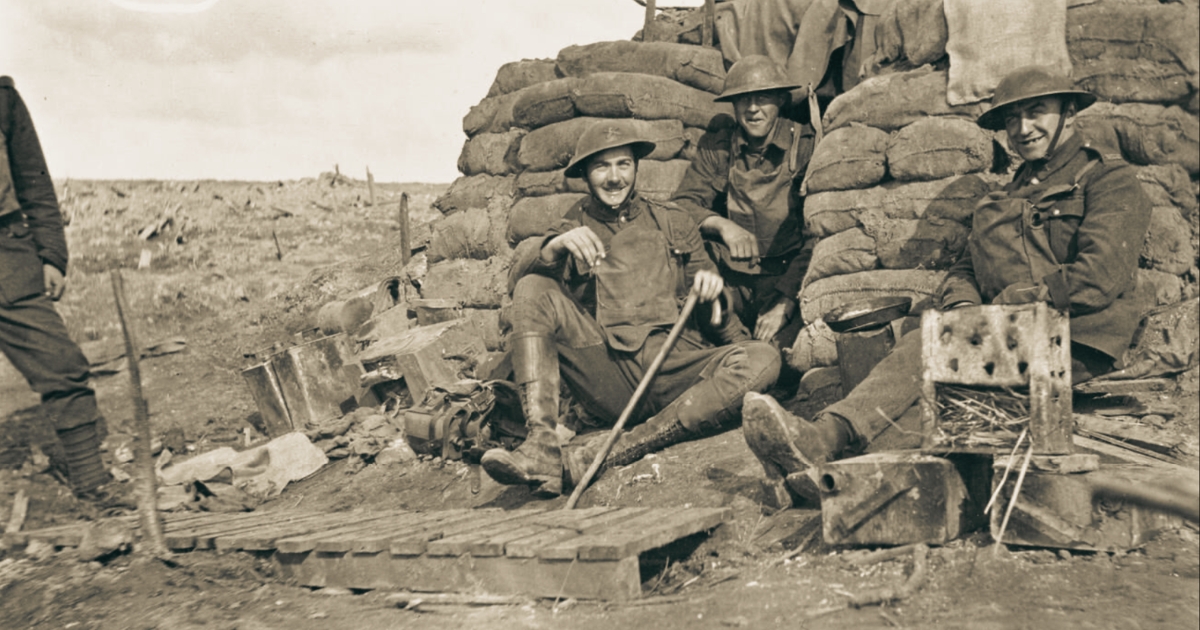
Main Image: Tyne Cotts Pillbox. After capture it became important position and Company Headquarters. Top – Capt Cross MC, 33rd Battalion MGC with runner and batman. (IWM Q56253)
Sign up for the free podcast newsletter here: Old Front Line Bulletin.
You can order Old Front Line Merch via The Old Front Line Shop.
Got a question about this episode or any others? Drop your question into the Old Front Line Discord Server or email the podcast.
6 Comments on “Questions and Answers Episode 48”
Leave a comment


 Old Front Line
Hi Paul
You said in the recent Q&A you did not know of any soldier’s memoirs where they served as a batman or officer’s servant.
No doubt you have a copy of George Coppard’s ‘With a Machine Gun to Cambrai on your bookshelves. In Section 18 ‘Return to the Hohenzollern Redoubt’ he describes being appointed as batman to a Lt James Wilkie (MGC). He says, “was I recommended or relegated for the job? – I don’t know”. He then goes on to describe his relationship with the officer and his duties. In Section 20 ‘The Somme Battle’ he is back on a gun crew and reflecting on his time as a batman said ‘although it had it s good points I felt less of a complete soldier” and was glad to be back with his mates.
His feelings had echoes of your description in the ‘left out of battle’ Q &A where you recalled a veteran telling you he didn’t want to be left behind when his mates were attacking.
George of course was an under age soldier, enlisting in 1914 in the Queen’s age 16, which may have been why he was given the job, but neither he nor we will ever know.
LikeLike
Thanks for this – I had totally forgotten that aspect of his memoirs. Going to go back and read that now!
LikeLike
I always recall an RAC veteran from Normandy saying they got a Sherman tank that had been ‘repaired’ and hosed out after an ‘incident’ do you know if a similar thing happened in the Great War?
LikeLiked by 1 person
I haven’t read of it, but there are some very graphic German photos showing tanks which had brewed up and which may then have later entered German service.
LikeLiked by 1 person
Thanks Paul for the info on The Killing Ground. I watched it earlier this week and I thought that it was excellent. I thought that your comments about the apparent lack of visitors was interesting too. I feel the same way about the Malcolm Brown / Leo McKern documentary about the Somme 10 years earlier, ie I was struck by the emptiness of the landscape, which would change 20 years later.
Dated they may be, but in my view, classics that are hard to beat.
Interestingly in the early 90s, the McKenna brothers, Bruce and Terence, produced a series about the Canadians in WW2 called the Valor and the Horror. There were three episodes; the fall of Hong Kong, the Bomber Offensive and the battle of Verrieres Ridge in Normandy.
The last two were controversial because of the alleged indiscriminate bombing of German civilians by the RCAF and alleged war crimes by the Canadian army in Normandy. The same format was used as the Killing Ground and all three can be viewed on YouTube.
LikeLiked by 1 person
Thanks Stephen – yes I saw the WW2 version when it was first broadcast in the UK in the early 90s. Like you say was a bit of a hot potato.
LikeLiked by 1 person