Old Front Line
WW1 Podcast with Paul Reed
Questions and Answers Episode 46
In this latest First World War Q&A episode we tackle some of the most intriguing and overlooked questions about life, strategy and survival on the Western Front and after the guns fell silent.
Why did the British Army so often attack on ground not of its own choosing, at places like Loos and the Somme? If British commanders could have picked the battlefield, where might they have fought instead, and why?
We then explore the everyday realities of the British Army by looking at the role of regimental cooks: were they safe behind the lines, or did they have to fight as front-line soldiers too? And if so what examples do we have of this?
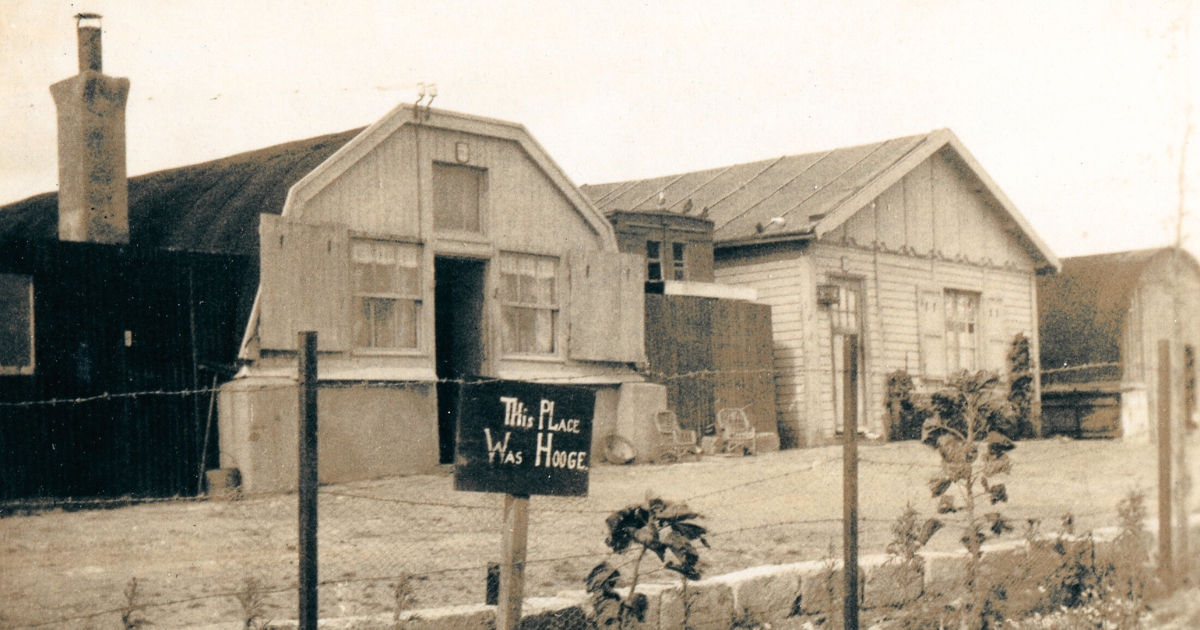
Moving beyond the Armistice, we examine what happened when civilians returned to their shattered towns and villages after the Great War. Did governments help rebuild devastated communities, or was the burden carried by charities and local people? How were homes, farms and businesses reconstructed across the former battlefields of France and Belgium, and who actually paid for the enormous clean-up of the Western Front? We look at unexploded shells, wrecked trenches, barbed wire and battlefield debris, and ask whether German reparations really covered the cost.
Finally, we investigate one of the visual trademarks of First World War battlefields: blasted woodland reduced to splintered stumps. If forests offered little cover and tangled roots made digging trenches harder, why were woods and copses fought over so fiercely?
A deep dive into strategy, soldiers’ daily lives, post-war reconstruction and the scarred landscapes of the Western Front, this episode sheds new light on how the First World War was fought and how its aftermath reshaped Europe.
Main Image: ‘This Place was Hooge’ – Provisional housing at Hooge in c.1919/20 (Old Front Line archives)
Sign up for the free podcast newsletter here: Old Front Line Bulletin.
You can order Old Front Line Merch via The Old Front Line Shop.
Got a question about this episode or any others? Drop your question into the Old Front Line Discord Server or email the podcast.
12 Comments on “Questions and Answers Episode 46”
Leave a reply to elizabethmckernan1 Cancel reply


 Old Front Line
Very interesting Q&A yet again & shows how many interesting intrigues exist about the war & how historians have spent great chunks of their lives & in the case of Paul Reed, have spent almost all of his working life studying the conflict in great depth to include the first hand accounts of those that lived & fought through it.
Imagine then the threat to that knowledge presented by these dodgy AI based platforms that peddle complete rubbish in the stead of facts, but who increasingly have online exposure & whose content is so ‘believable’ to the unaware.
It also doesn’t help when the ‘Leader of the Free World’ makes ignorant claims about the ending of the conflict to justify his own previous failings.
During his address at the World Economic Forum (WEF) in Davos on 21 January 2026, Donald Trump made several controversial claims regarding history and pandemics.
Trump claimed that the Spanish flu was the primary reason World War I ended. He stated, “World War I ended because all the soldiers were sick… they were all dying from the Spanish flu. They were sick as dogs. They couldn’t fight”.
Why let the facts get in the way of a self serving ruse but he denigrates the memory his country’s own forces who lost their lives fighting until the Germans were beaten which had much more to do with the allies’ fortitude than the effects of any disease.
I guess he’d challenge the fact that the only reason for it being called ‘Spanish’ was because that country was free to report the pandemic as, being neutral, they didn’t need to suppress it’s existence for fear of it having a negative effect on the battlefields. He’d also not be able to cope with the fact that the pandemic was an American import exported via the Doughboys I believe.
So the historical truth, whether you like or not, needs to be published & thankfully we have the likes of Paul Reed to do that for us.
Ian
LikeLiked by 1 person
Thanks, Ian. I just think we all need to be aware of both the benefits of AI (there are some) but importantly the dangers too for many of the reasons you mention.
LikeLike
Yes Paul,
There are. But who is the arbiter? If used for the mundane, that the human may become tired & thus make a mistake or miss something important, then that’s a great use, however, when the input parameters aren’t set carefully you get wrong assumptions. Rubbish in = Rubbish out. Then there’s ignorance !!!!!!
LikeLiked by 1 person
>
LikeLike
Hi Paul, I have tried before to put up a comment but it is too complicated for me! I was interested in your comments about AI. As a Catholic I have seen videos online which seem to be genuine about Pope Leo but which on further inspection are entirely fictitious. I wonder why people are doing this. What is their aim? The first one I watched was about a ‘visit of Pope Leo to a little girl in hospital’ which seemed genuine enough. However when the voice over said that ‘he returned to see her ‘several months later’ I smelled a rat as he had only been elected a couple of weeks before I watched it. Then it said that he presented her with a mother of pearl rosary and in the video the rosary was black. It was only after I clicked on the origin of the video that it said all the stories were fictitious. This should be under the video being watched. How many people are going to bother doing this ? Best wishes Liz McK
>
LikeLiked by 1 person
Thanks Liz – yes, so many examples of it being used to create fake narratives and that’s very dangerous in all kinds of ways.
LikeLike
PS If I feel prompted to put up a comment can I send it to you by email? liz mck
>
LikeLiked by 1 person
Yes you can contact me here: https://oldfrontline.co.uk/about/
LikeLike
Interesting to hear about the impact of AI. However, given that Blackadder is regarded by some as ‘history’ then I can’t say that I’m surprised.
Interesting also to hear about post war reconstruction. The main regiment in my neck of the woods, Southport, was the King’s Liverpool Regiment, with many battalions fighting in the area of the ‘Forgotten front’. In the 1920s Liverpool adopted Givenchy and Southport, Festubert and the citizens of Liverpool and Southport raised money for the rebuilding of their respective town/memorial halls.
I believe that there are plaques expressing the gratitude of the returning inhabitants of Givenchy and Festubert to the people of Liverpool and Southport and these are on display at their respective halls. In the 1920s and 30s there were exchange trips of school children between Southport and Festubert. These stopped in 1939 and we’re not resumed post WW2.
LikeLiked by 1 person
The plaques are still there, Stephen!
LikeLike
That’s good to know Paul! Unfortunately we didn’t have time to visit Festubert on the Forgotten Front tour in July 2024. I have noticed that I added my original comment for this podcast in the thread for the London Pride one in error so could you remove it for me please?
LikeLiked by 1 person
All sorted!
LikeLiked by 1 person