Old Front Line
WW1 Podcast with Paul Reed
Questions and Answers Episode 40
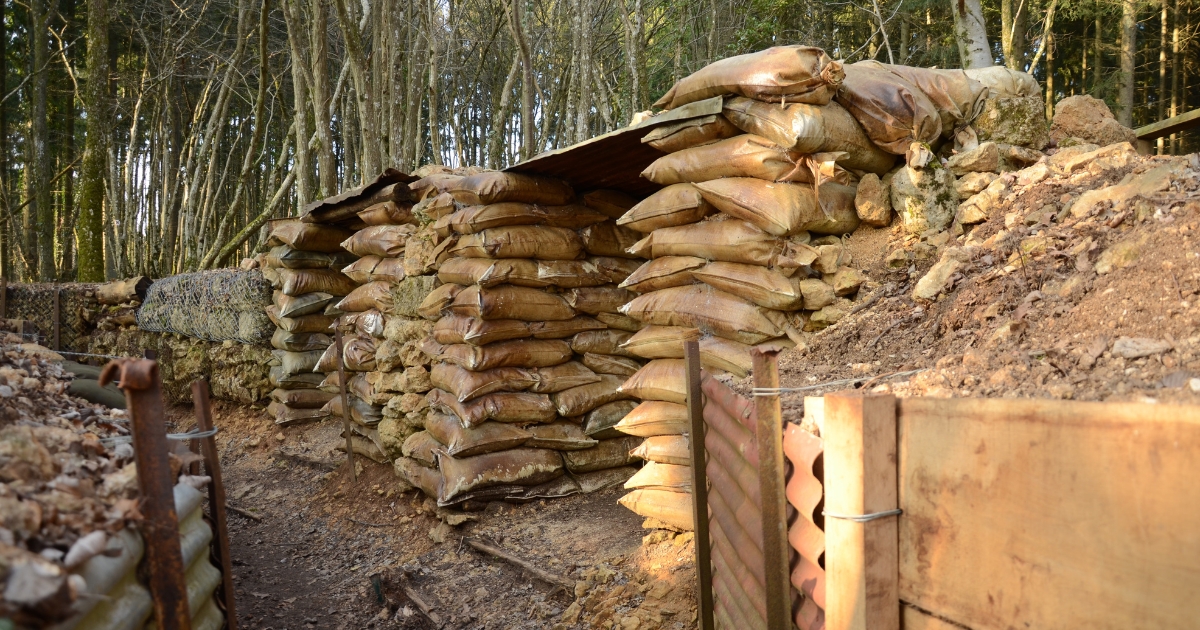
In this 40th Questions and Answers episode, we explore some of the lesser-known battlefields of the Western Front, uncovering places where traces of the First World War fighting can still be seen today.
We examine what really happened to trenches after they were captured in battle, discuss whether WW1 historians face a new challenge from Artificial Intelligence, and debate the nature of First World War generalship — were those in high command truly butchers and bunglers, or more capable than history has allowed?
Sign up for the free podcast newsletter here: Old Front Line Bulletin.
You can order Old Front Line Merch via The Old Front Line Shop.
Got a question about this episode or any others? Drop your question into the Old Front Line Discord Server or email the podcast.
12 Comments on “Questions and Answers Episode 40”
Leave a reply to starstruck5f46965e3b Cancel reply


 Old Front Line
Another great listen, I always look forward to Saturday mornings and listening to your latest broadcast. You stimulate an interest in exploring and enquiring like no other and once again you have done this in your answer to question one. Could you list the five overlooked sites please, I have listened to the answer twice and looked at the text on You Tube but my poor hearing and lack of French pronunciation of place names has stumped my research. I used your beyond the Somme podcast and others on the area to explore The Chemin De Dame earlier this year including an excellent few hours at La Main De Massiges. Keep the great work up.
LikeLiked by 1 person
Of course, the sites I mentioned were:
– the railway line at Pervyse in Flanders.
– the German trenches at Soyecourt on the Somme.
– The Bois Brulé near the village of Marbotte in the St Mihiel Salient.
– The Bois-le-Prêtre near Pont-à-Mousson.
– Le Linge, the trenches cut into the rock in the Vosges.
Thanks for your kind comments.
LikeLike
Congratulations Paul on another Podcast milestone. Really love the Q&As, very interesting and unique questions every episode.
Keep up the great work, thanks John
LikeLiked by 1 person
Thank you, John!
LikeLike
Thanks Paul, an excellent 40th Q&A. I particularly liked your very balanced comments on ‘AI’ & ‘The Generals’.
LikeLiked by 1 person
Thank you, Brett!
LikeLike
Hello Paul. Just to Clarify, I am the person who asked the question about the number of battalions a specific regiment would have in the First World War. My name is Michael Denesyk, I live in Toronto, Canada. I am an artist and recently did a painting of one of the 20 unidentified Canadian soldiers who were photographed at Vignaourt Farm. There is a museum there and I received permission to paint from one of the glass plates. In all, there are 3000 glass plates. The museum is near to Arras, The Museum is called VIGNACOURT 14|18
Cheers, Michael Denesyk, Toronto Canada
LikeLiked by 1 person
Hi Michael – thanks, and this is great to know, and thanks for your question! I know Vignacourt, I was one of those who helped saved all the images and we feature the museum there on many of our battlefield tours.
LikeLiked by 1 person
Thanks Paul. I left you a text message about the Somme, and why it is called the battle of the Somme and why it is not referred to as the Somme Campaign? July 1 to November 18 is a very long battle, would it not be more accurate to call this a campaign and not a battle?
LikeLiked by 1 person
Congratulations on your 40th Q and A Paul. The last two questions were especially interesting, I have always thought that the main problem of the Great War was that the hardware (weaponry)was way ahead of the software (communications).Your comments about the learning curve, which I generally agree with, took me back to the 1st question of your second Q and A where you said that Garry Sheffield was revising his view on this. Does this mean that he no longer believes in the ‘Learning Curve’ and where can I find out more about this?
LikeLiked by 1 person
Thank you, Stephen! I’ve heard Gary speak about the Learning Curve and say that he believes it wasn’t so much of a curve as was made out in the early years of the use of that term.
LikeLike
Cheers thanks Paul, definitely food for thought!
LikeLiked by 1 person