Old Front Line
WW1 Podcast with Paul Reed
Questions and Answers Special: WW1 Ancestors
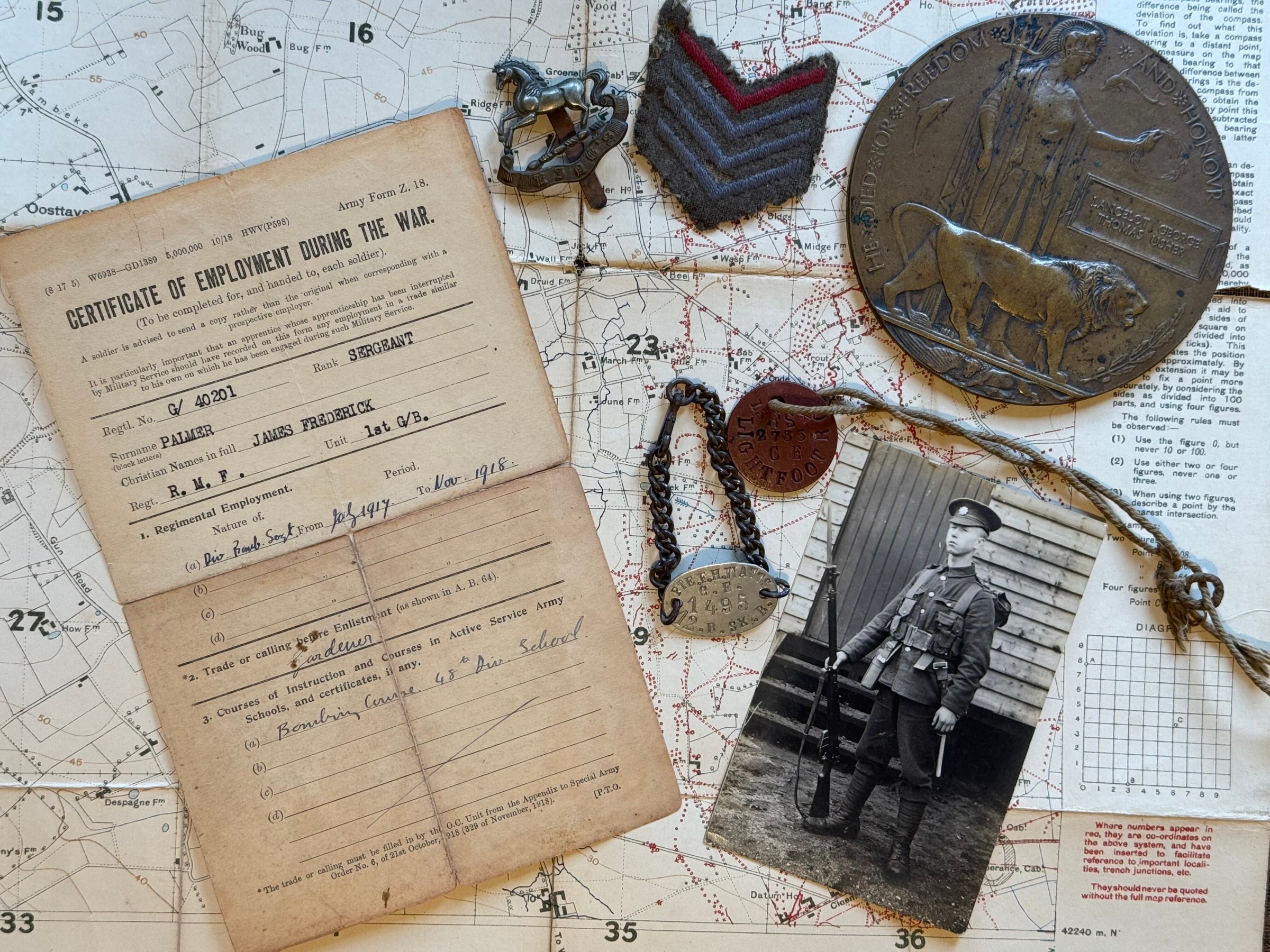
In this special edition we look at how trace to service men and women who fought and died in the Great War. We cover a number of questions covering different aspects of how to trace your WW1 Ancestors from many different nations, but in particular from Britain and the Commonwealth.
USEFUL LINKS:
Western Front Association Pension Files website
Grand Memorial – Tracing French WW1 Records
Long, Long Trail website – Chris Baker
Got a question about this episode or any others? Drop your question into the Old Front Line Discord Server or email the podcast.
7 Comments on “Questions and Answers Special: WW1 Ancestors”
Leave a comment


 Old Front Line
This was a most interesting Q&A. I would very much like to find my grandfather’s military history from his time in The Great War with the Royal Engineers but, to date, have had no idea where to begin. He died in 1966 and, according to what my father told me, would never speak about his experiences. I have just two photographs of him in his miltary uniform. So, wish me luck.
LikeLiked by 1 person
Good luck and let us know how you get on!
LikeLike
Cheers Paul, this has been really helpful. Particularly. it’s the first time (after a number of times asking) someone has explained the Battalion numbering system & I’ve understood it! Keep up the good work.
LikeLiked by 1 person
Thanks John and thanks for your support, too.
LikeLike
Thanks for an excellent Q&A Paul. Q3 reminded me of my great uncle, Stanley Hunt, born in Warrington ( then Lancashire) in 1900 who was killed in April 1918 while serving with the Norfolk Regiment. He was subsequently buried at Mailley-Maillet. I doubt if, in his short life, that he went anywhere near Norfolk.
I have also heard that the dispersion of recruits to regiments far from their normal enlistment areas, was a deliberate government policy to avoid a repetition of the disasters of the Pal’s battalions on the Somme, and to keep public opinion in favour of the war. It was no doubt bad enough for the likes of Accrington in 1916, but if similar disasters befall these towns in 1918, then there was a possibility that their mood would have turned against the war.
LikeLike
Hi Paul, great podcast as always. I was particularly interested to hear that you did your MA on the London Regiments, hopefully this will be expanded on in the future!?
I have just discovered a new (to me) way to confirm a soldiers details / service which may be of use to your listeners. I have one branch of my family where 3 of 5 brothers died in WW1 and I know, anecdotally, that the 5th joined up under age but never served so I couldn’t imagine that the other son didn’t serve. The problem was, with no surviving service record and a few similar names I couldn’t track his service with any certainty. Then, purely by chance, when adding 1921 census details on Ancestry I also found the 1918 electoral list that has a section for Absent Voters, and there he was!
If you know the address of your soldier, maybe from the 1911 census or other source, then you can find them on here and it gives you the Service No, rank and regiment of your soldier. You can then use these to get the MIC / Roll etc.
Hopefully this will help others.
Chris
LikeLiked by 1 person
Thanks for this, Chris!
LikeLike